
For a steel plant, a hospital or a cement manufacturer, a cyber incident is not an abstract IT problem. It is a halted production line, a delayed patient record or a missed dispatch. The real test of a security programme is how quickly the business gets moving again.
That idea shaped many of the conversations Vembu had at the 17th edition of UBS Forums’ CISO Conclave & Awards 2026, held on 28 October at ITC Sonar, Kolkata. The event brought together security and technology leaders from BFSI, logistics, retail and government, among other sectors. Vembu was represented by Pranav PK, Product Manager, and Ravishankar, Director of QA and Dev Ops.
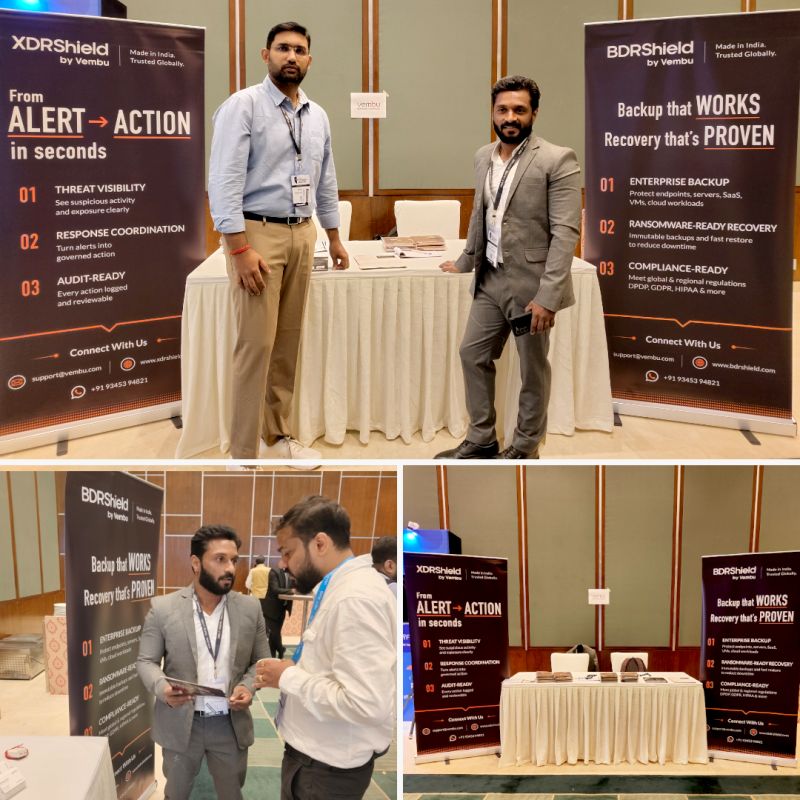
Who we met in Kolkata
The people who stopped at the Vembu booth gave a clear picture of the region’s business landscape. Manufacturing was especially well represented, spanning steel, iron and ferroalloys, cement, industrial gases, paints and chemicals, carbon products and renewable energy equipment. We also spoke with leaders from healthcare and hospitals, education, retail and footwear, real estate and hospitality, infrastructure and railway engineering, financial services and stock broking, agriculture, and IT and cybersecurity services.
Seniority was high. Visitors included CIOs, CTOs, general managers and group heads of IT, alongside heads of information security and cybersecurity programme leaders. These are the people who carry responsibility for both keeping systems running and answering for them when something goes wrong.
What the conversations centred on
Backup and cyber resilience came up repeatedly, and several delegates asked specifically about BDRShield and follow-up discussions. There was also interest in how XDRShield could add detection and response capabilities alongside data protection.
The combination makes sense. In sectors where downtime has a direct operational and financial cost, organisations tend to ask two linked questions. How early can we detect suspicious activity? And if it still causes damage, how reliably can we restore what we need?
The conversations also reflected how varied the audience was. A manufacturing CIO, a hospital IT head and a financial services technology leader each have different systems and different tolerances for disruption, but they share the same underlying concern: an incident should not become a prolonged outage.
How BDRShield and XDRShield respond
Vembu’s two products address different stages of that problem.
BDRShield focuses on data protection and cyber recovery. Capabilities such as immutable backups, ransomware detection, secure access, recovery validation and clean recovery are designed to help organisations restore data and workloads with confidence. Immutability helps protect backup copies from being altered or deleted. Recovery validation helps confirm that a backup will actually restore when it is needed.
XDRShield focuses on threat detection and response. It gives security teams endpoint visibility, correlates suspicious activity and supports the move from detection to investigation and response. For teams that want earlier warning and a more structured response, it addresses the detection side of the picture.
Used together, the products can support both ends of an incident: identifying and responding to a threat, and recovering if prevention falls short. Each works on its own, and neither replaces the other.
The takeaway from Kolkata
Cyber resilience is ultimately measured in operations, not tools. The organisations best placed to handle an incident are those that combine early visibility with recovery they have actually tested.
Our thanks go to UBS Forums for organising the Kolkata edition, and to every delegate who took the time to talk with the team about how their organisation approaches backup, security and continuity.
Vembu remains committed to helping organisations strengthen their data protection, cyber resilience and business continuity.

