
As organisations adopt AI, cloud-native infrastructure and automation, their data estate grows and so does the cost of losing access to it. That makes one question harder to avoid: if something goes wrong, how quickly and how confidently can the business recover?
That question sat behind CISO Horizon 2026, held from 9 to 11 October at Mayfair Spring Valley Resort in Guwahati, Assam. The summit was organised by Tech Disruptor Media, with Bharat Network Group as the initiative’s parent brand. This was the first edition of an invitation-only residential summit that brought together CISOs, CIOs, risk leaders and security architects from banking, manufacturing, healthcare, energy, government and other sectors. Its theme was Cyber Resilience in the Age of AI: Securing the Intelligent Enterprise.
Vembu took part as an exhibitor, represented by Sakthi Prian, Senior Channel Manager, and Nagarajan Chandrasekaran, Vice President – Product Success.
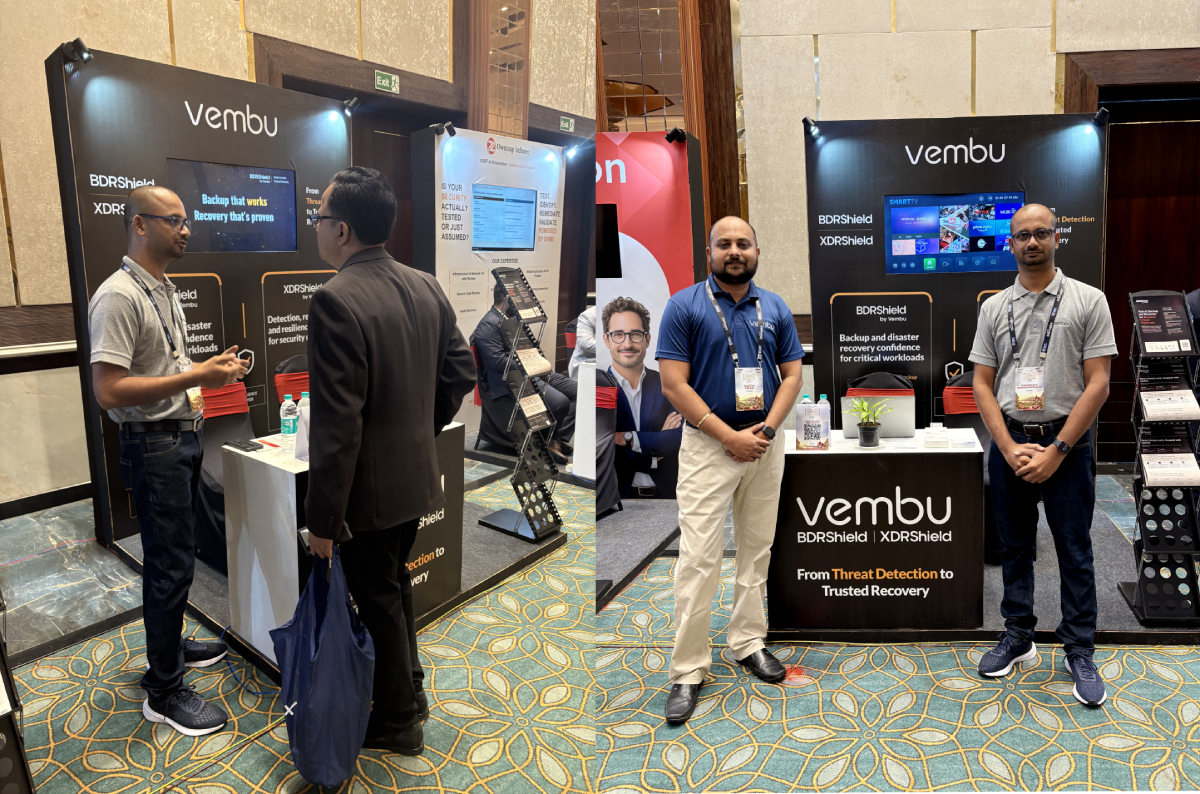
A Different Kind of Summit
CISO Horizon was deliberately built around conversation rather than volume. The three-day residential format combined executive roundtables, product demonstrations, one-to-one meetings and informal networking. Cyber resilience, data protection and security operations were among its core focus areas.
For a team that spends its days on backup, recovery and threat response, that format is valuable. Resilience decisions rarely come down to a single product feature. They depend on questions that suit a roundtable better than a slide deck:
- Are recovery plans tested, or only documented?
- Can critical data survive an attack that targets backups as well as production systems?
- Do security teams have the visibility and control to respond quickly, with a clear record of what was done?
Two Products, Two Stages of an Incident
Vembu’s work on these problems is split between two products with distinct roles.
BDRShield by Vembu focuses on data protection, recovery and business continuity. The capabilities most relevant to the summit’s themes are:
- Encryption in transit and at rest, managed from a centralised console
- Immutable backups with retention lock, to help protect recovery points from tampering or deletion
- Air-gapped and offsite copies, which provide a recovery route independent of the primary environment
- Automated backup verification and recovery testing, so teams can confirm that restores work before they are needed
- Instant recovery for VMs and physical servers, to help reduce downtime
XDRShield by Vembu focuses on threat detection, investigation and response:
- Continuous endpoint monitoring across files, processes, registry and network activity
- Case-based investigation, with timelines, notes and evidence in one place
- Controlled response actions, including host isolation, process termination and file quarantine, supported by approval workflows and playbooks
- Activity logging, so every investigation step and response action can be reviewed
XDRShield helps teams detect, investigate and contain a threat, while BDRShield helps protect critical data and prepare for recovery. They are separate products addressing complementary stages of resilience.
The Takeaway
An intelligent enterprise still depends on the basics: data that can be recovered, threats that can be contained, and processes that can be audited afterwards. Resilience is built on those capabilities long before an incident, and the strongest security programmes treat prevention, response and recovery as one continuous effort.
We thank Tech Disruptor Media for hosting us, and the security leaders who made time for conversations in Guwahati. We look forward to continuing them and to helping more organisations strengthen their data protection, security operations and business continuity.
Follow our Twitter and Facebook feeds for new releases, updates, insightful posts and more.

