
When a ransomware incident hits a manufacturing plant, the question rarely stays technical for long. How quickly can production restart? Which systems can be trusted? Is the last clean backup actually clean?
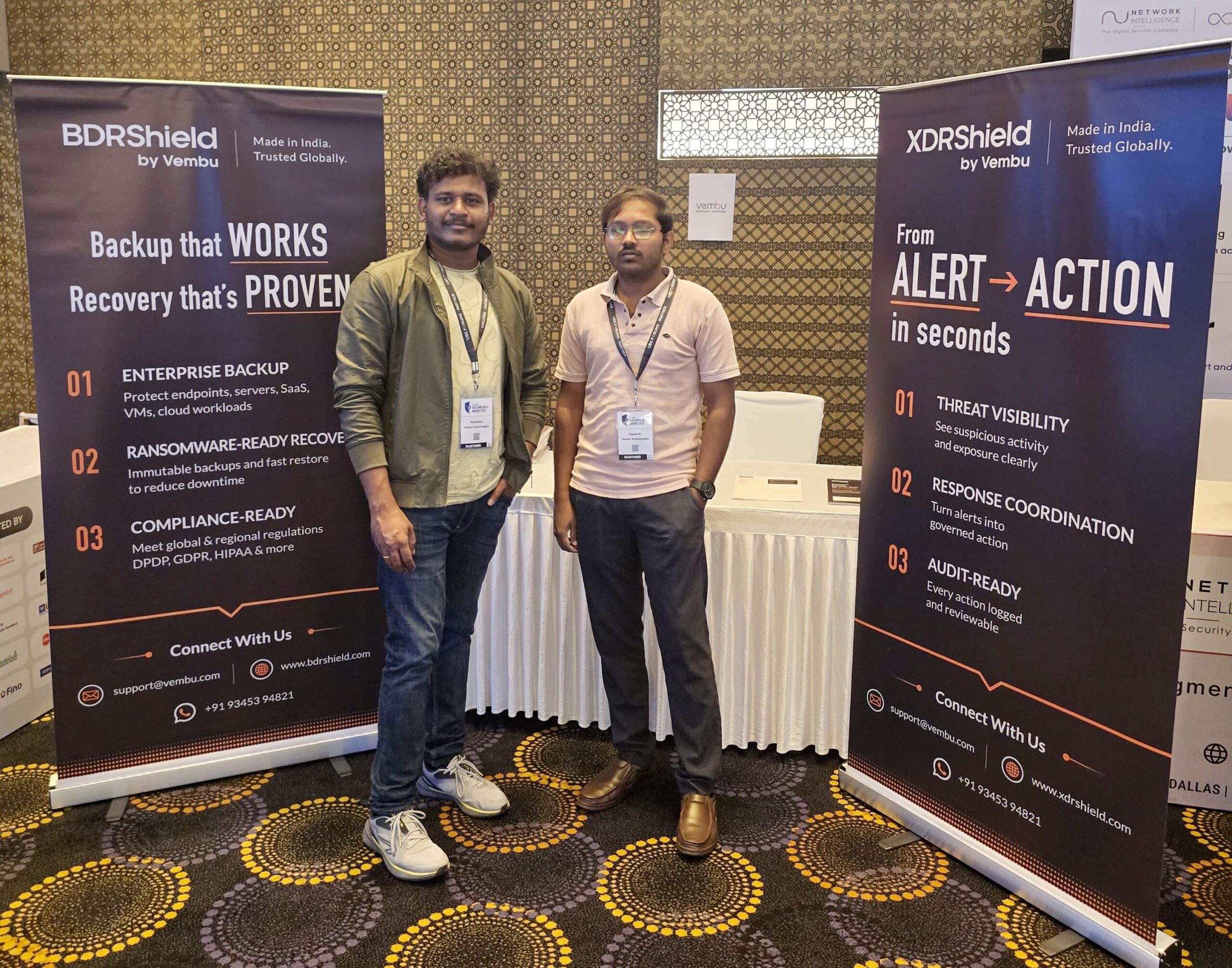
Those were the questions in the background when Vembu joined UBS Forums’ CISO Conclave & Awards 2026 in Pune on 22 October. The event was held at Novotel Pune Nagar Road, as part of a five-city India tour, and brought security leaders together from the automotive, IT, manufacturing and defence sectors. Vembu took part as an exhibit partner, represented by Manickam Ramasamy, Senior Technical Architect (Software Development), and Dinesh Ramalingam, Technical Manager & Architect.
Why Pune’s industries face a particular kind of pressure
Pune’s mix of automotive plants, IT services and defence-linked manufacturing makes for a demanding security environment. These organisations run complex, interconnected operations where downtime is costly, and where customer, design and production data must remain both protected and recoverable.
The conclave’s programme reflected this. Its agenda covered ransomware resilience, data protection, regulatory compliance and the use of AI in security, with a stated emphasis on real-life insights rather than theory. One session theme asked how to get the most protection from technologies, organisations already own, which is a practical concern for security teams under budget and staffing pressure.
For Vembu’s team, the setting was a useful reminder. Security strategy is increasingly judged by how well an organisation can detect trouble early, respond in a controlled way and return to normal operations afterwards.
Two halves of the same resilience question
Vembu’s presence at the event centred on two products with distinct roles.
BDRShield addresses backup, data protection and recovery. It is a cloud-managed hybrid backup platform, with central management of backups across endpoints, servers, virtual machines, cloud and SaaS workloads, and a choice of local and cloud storage. It also includes immutable backups, which matter because ransomware increasingly targets backup repositories as well as production systems. A backup that an attacker can alter or delete is not much of a safety net.
XDRShield addresses a different stage of an incident. It is an extended detection and response platform focused on endpoint visibility, correlating suspicious activity and moving from detection to investigation and response through defined workflows. It helps security teams see what is happening on their endpoints and act on it with clearer oversight.
The two work at different points in the incident lifecycle. XDRShield is concerned with spotting and responding to a threat; BDRShield is concerned with making sure the business can recover its data if prevention falls short. Neither replaces the other, and organisations with mature security programmes tend to plan for both.
The takeaway from Pune
The conclave reinforced a simple point: resilience is not a single control. It is the combination of visibility, response discipline and tested recovery. For CISOs and IT leaders, the useful question is not “Which tool stops everything?” but “If something gets through, how quickly and confidently can we recover?”
Our thanks go to UBS Forums for organising the Pune edition, and to the security leaders, partners and delegates who took the time to visit the Vembu team and exchange views.
Vembu remains committed to helping organisations strengthen their data protection, cyber resilience and business continuity.

