VembuHIVE: BDRShield’s Patented Backup File System
for Faster Recovery, Storage Efficiency, and Data Integrity

A BDRShield Whitepaper by Vembu Technologies

Executive Summary
Backup used to be judged on one question: did it happen? That question isn’t enough anymore. Attackers now deliberately target backup repositories before they ever touch production systems, regulators increasingly expect a provable, auditable recovery history rather than a checkbox, and businesses want more from their backup data than an emergency copy sitting untouched until disaster strikes.

Meeting that broader set of demands starts with the file system underneath. General-purpose file systems are efficient at writing, organizing, and reading data, but they were never built for backup’s specific demands: fast recovery, verifiable integrity, and intelligent access to what’s stored. VembuHIVE is BDRShield’s answer, a proprietary, patented file system built entirely in-house and engineered specifically for backup and disaster recovery, and the foundation everything BDRShield does is built on.

This whitepaper explains how VembuHIVE is architected and what that architecture makes possible: recovery speed, cross-platform data mobility, storage economics, data integrity and compliance, granular recovery, and direct access to any historical version of a backup.

VembuHIVE: BDRShield’s Patented File System
VembuHIVE is BDRShield’s proprietary, patented file system, purpose-built for large-scale backup and disaster recovery. Rather than storing backups as a collection of files the way a conventional file system would, VembuHIVE treats its repository as a document-oriented database and virtualizes that repository as a file system on top. It can be described as a file system of file systems: it separates the actual data from all of its bookkeeping, its metadata, stores each independently, and reconstructs whichever format an application needs on demand.

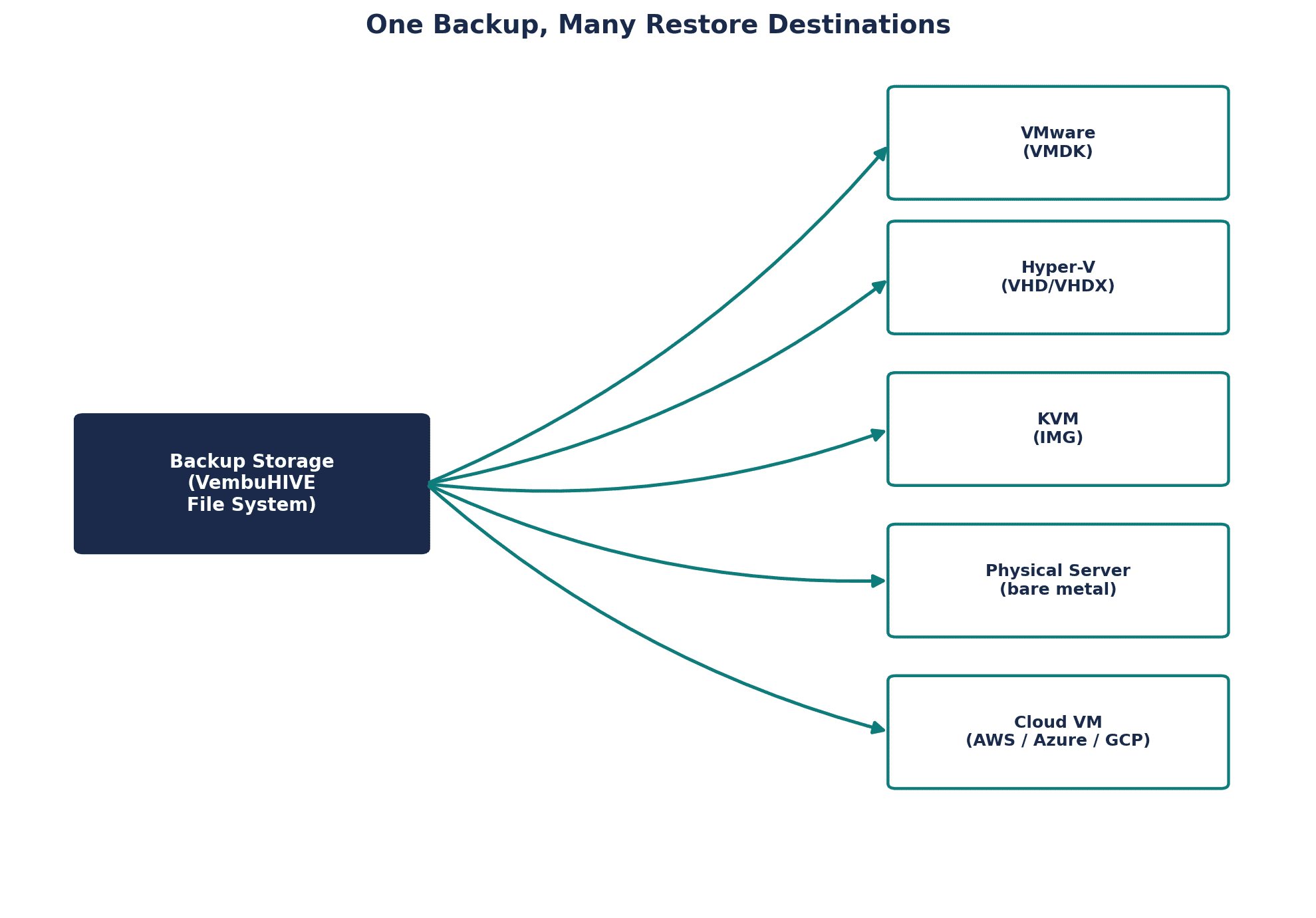
During a backup, VembuHIVE separates out the metadata associated with a file, disk image, or virtual machine, its file-to-sector mapping, directory hierarchy, and the native file system used to create it, and stores that metadata apart from the raw data itself. Metadata and data are decoupled, so VembuHIVE can present the same underlying backup as a VMDK, VHD, VHDX, or raw image file without any additional storage or processing overhead.

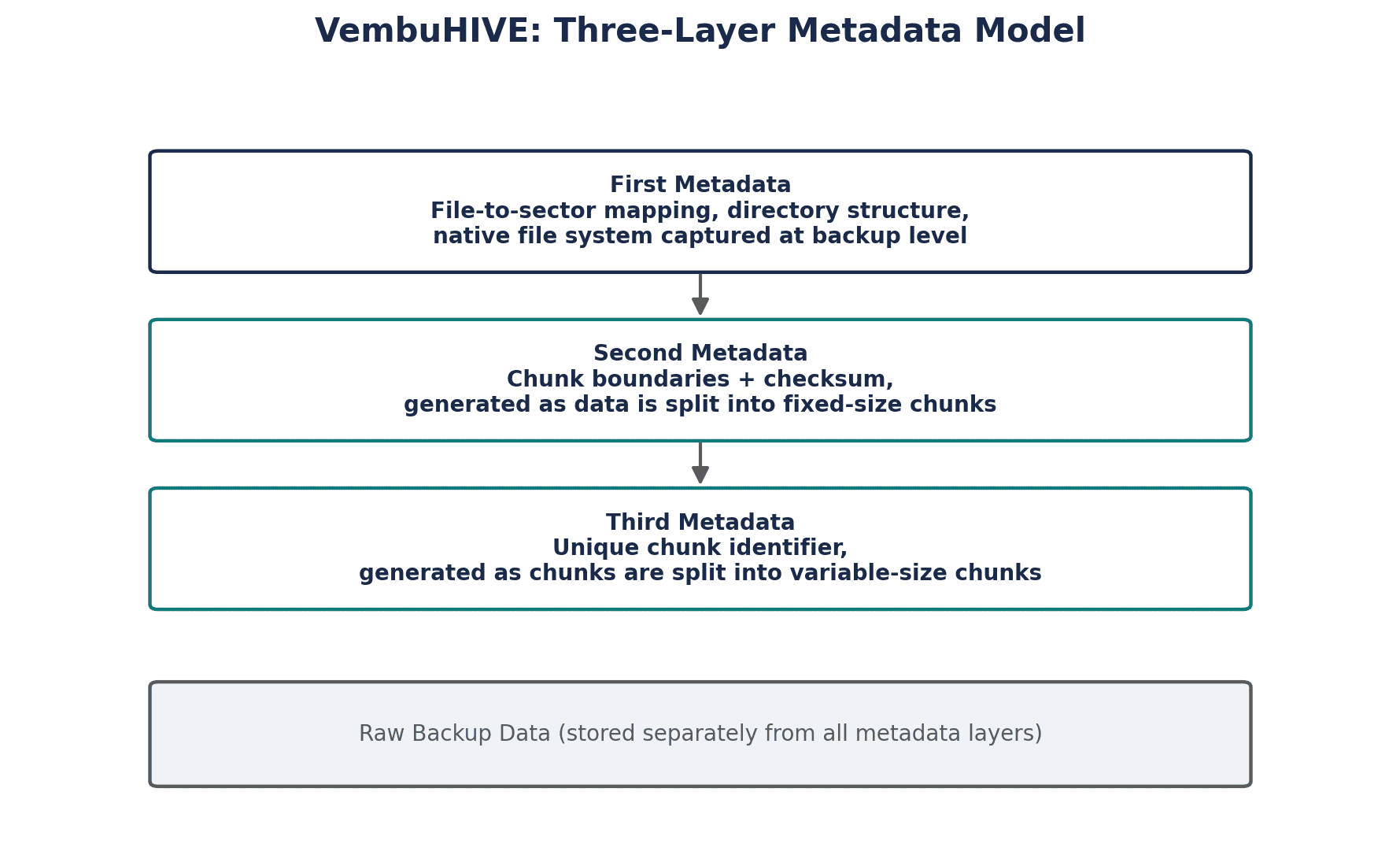
This architecture is documented in a granted US patent, “Secure Relational File System with Version Control, Deduplication, and Error Correction,” and works through three layers of metadata: a first layer, generated at the backup level, that captures file-to-sector mapping and the native file system structure; a second layer, generated as data is split into fixed-size chunks, that records chunk boundaries and a checksum used to detect what changed between backups; and a third layer, generated as those chunks are further split into variable-size chunks, that holds a unique identifier used to detect duplicate data across the entire backup set.
VembuHIVE

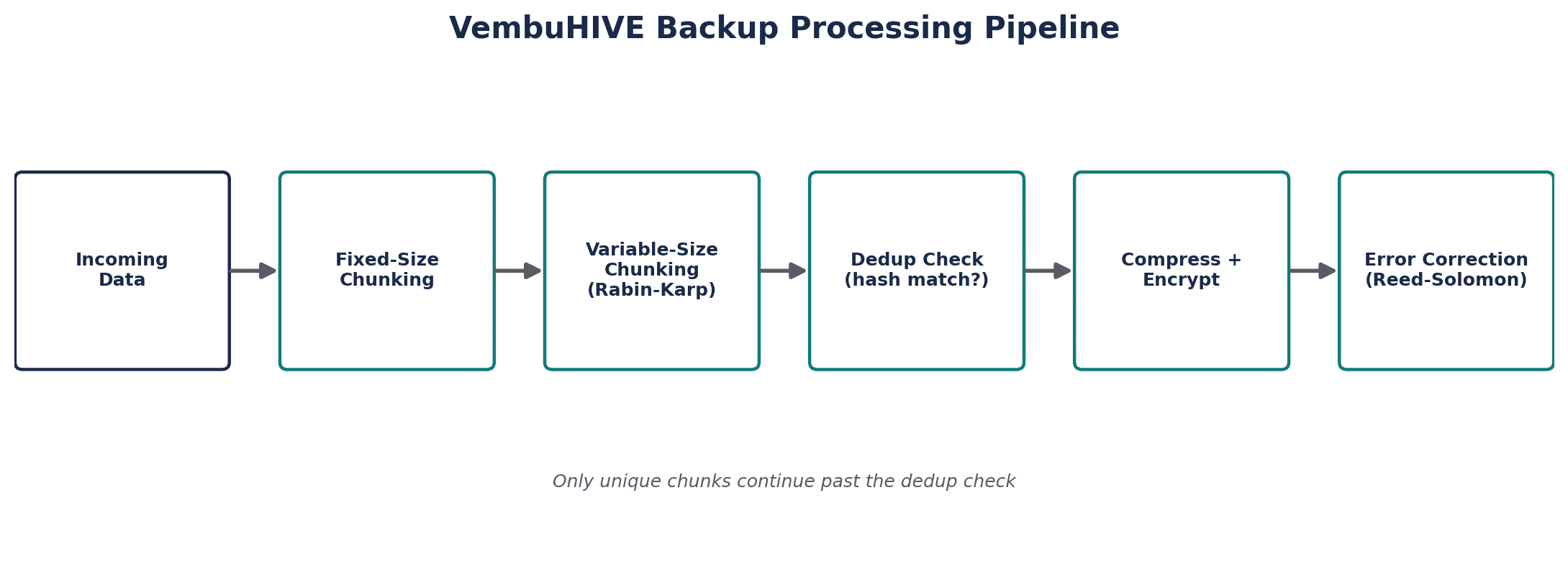
Underneath that metadata structure sits a defined processing pipeline. Incoming data is split into fixed-size chunks, then further split into variable-size chunks using context-aware breakpoints. Each variable-size chunk is fingerprinted with a cryptographic hash and checked, inline, against everything already stored: a match means only a pointer needs to be recorded, and no match means a new, unique chunk gets saved. Only unique chunks are compressed and encrypted before being written to storage, and parity information is added at the chunk, repository, client, and backup level using error correction techniques.

VembuHIVE

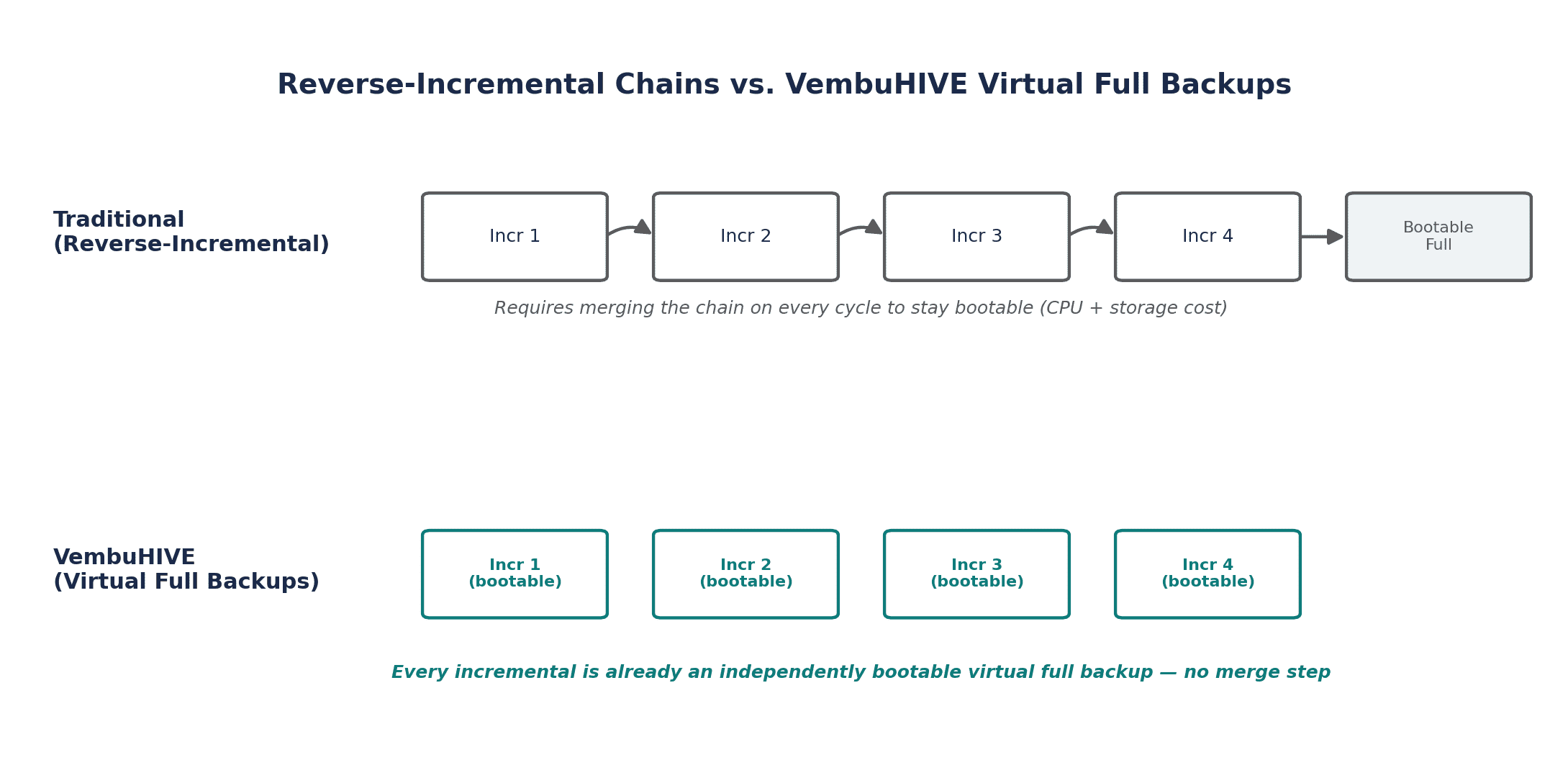
Every incremental backup’s metadata is stored independently and references only the exact chunks that changed, so VembuHIVE can expose any point in time as a complete, virtual full backup, without ever merging that increment into a chain of previous ones. The result is a repository that behaves less like a folder of backup files and more like a searchable, versioned database. What follows walks through what that database architecture actually changes.
Speed: Recovery Without a Rebuild
Every incremental is a virtual full backup rather than a dependent link in a chain, so a point-in-time restore is available the moment a backup completes, with no reverse-incremental merge or chain replay required first. Many competing platforms rely on exactly that kind of merge to keep a backup bootable, quietly consuming CPU and storage on every cycle; VembuHIVE skips that cost because a backed-up VM’s disk image is already stored as something the system can present directly as a mountable virtual disk.

VembuHIVE

In independent lab testing by openBench Labs, an active Exchange VM running a 2,000-mailbox workload was fully restored and running as a Hyper-V VM in under five minutes, with incremental backups of that same server completing in roughly 17 to 18 minutes under full production load, comfortably meeting a 30-minute recovery point objective. The same speed shows up at the file level: backed-up disks can be mounted directly on the backup server’s own disk management console, instantly exposing the contents of a backup as a live, browsable disk, so an administrator can pull an individual file or folder without waiting for a full restore or booting the underlying VM at all.
Mobility: Recovery That Isn’t Locked to One Platform
VembuHIVE stores data independently of any single file system’s structure, so the same backup can be presented on demand as a VMDK, VHD, VHDX, or raw IMG file. In practice, that means a VM backed up from VMware can be restored directly onto Hyper-V or KVM, a physical server can be recovered as a virtual machine, and a VM or physical server backup can be stood up as a cloud VM, all without a separate conversion step in between.

VembuHIVE

This kind of data mobility matters to anyone managing a mixed-hypervisor environment, migrating between platforms, or needing a cloud target to fail over to when on-premises infrastructure is down. It also quietly removes a decision businesses often don’t realize they’re locked into: once backup data is trapped in one vendor’s proprietary chain format, changing platforms later means starting over. VembuHIVE’s format-agnostic storage means the infrastructure underneath can change without the backup history being held hostage to it.
Economics: Storage That Scales Affordably
VembuHIVE’s deduplication is global, variable-length, and block-level: it identifies duplicate data across the entire backup set, not just within a single file or a single client’s backup job, and stores only one unique copy of anything it has seen before. For an MSP running backup across dozens or hundreds of client environments, that compounding effect is the difference between storage costs that scale linearly with client count and costs that scale with actual unique data, which grows far more slowly. Deduplication runs inline, as data streams in, rather than as a separate post-process job, so it doesn’t add a second storage tier or a cleanup step to manage.

That efficiency is paired with storage flexibility. VembuHIVE automatically scales across SAN, NAS, and DAS storage targets, and additional storage can be added without disrupting existing repositories or requiring a migration. A growing MSP or IT environment can add capacity as needed rather than re-architecting storage every time the client base or data volume grows. Together, inline global deduplication and non-disruptive scale-out storage are what keep the cost per protected workload predictable, which is precisely the number MSPs have to defend when pricing a backup service.

Integrity: Recovery You Can Prove
At the storage level, parity information generated through error correction techniques is maintained at the chunk, repository, client, and backup level. If a chunk becomes corrupted, whether from hardware failure, bit rot, or an incomplete write, VembuHIVE can reconstruct it from that parity data rather than losing the recovery point entirely, a layer of protection general-purpose file systems like NTFS or ext4 simply don’t provide on their own.

At the version level, because every incremental backup’s metadata is captured and stored independently, with its own checksum recording exactly what changed, VembuHIVE effectively maintains a verifiable, timestamped history of every recoverable state a system has passed through. That kind of granular, auditable version history is precisely what compliance frameworks like SOC 2, HIPAA, and India’s DPDP Act increasingly expect organizations to be able to produce: not just a claim that backups exist, but evidence of exactly what was backed up, when, and that it can be restored intact. For IT teams and MSPs fielding audit questions, VembuHIVE’s architecture is what makes “show me you can recover this, and prove it wasn’t altered” an answerable question rather than a leap of faith.

Granularity: Restoring Only What’s Needed
Not every recovery need is a full server or a full VM, and treating every restore as an all-or-nothing operation wastes time on the vast majority of real-world recovery requests, which are for one file, one mailbox, one document, or one deleted item.

VembuHIVE’s metadata describes the structure of what it backs up, not just the raw bytes, which is what lets BDRShield’s management console expose individual items directly, without restoring the whole backup first. From the same console, an administrator can browse into a backup and recover a single file, a specific Exchange mailbox, a SharePoint document, or a table inside a database, choosing exactly which item and which version of it to restore. This depends on the same application-aware backup approach that makes VembuHIVE consistency-aware in the first place: the system understands file and application structure at backup time, so it can navigate that same structure at restore time. For the person fielding a one-off “can you get back the email I accidentally deleted” request, this is the difference between a two-minute fix from the console and a full VM restore to retrieve a single item.

Differentiation: What Actually Sets VembuHIVE Apart
Fast recovery and scale-out storage are marketed features across this category, so the differentiation here isn’t that VembuHIVE does something no one else claims to do. It’s how that speed, and everything built alongside it, is achieved.

Competing platforms generally get there by layering optimizations on top of a conventional file system: a reverse-incremental merge to keep a backup bootable, an agent installed inside the VM’s guest OS to reach application-level data, or purpose-built hardware to hit an aggressive recovery window. Each approach works, but each also carries a cost, whether that’s CPU and storage spent on constant merging, additional agents to deploy and maintain, or dependency on specific hardware. VembuHIVE’s architecture treats independent recoverability, cross-platform mobility, deduplication, and integrity as properties of how data is stored in the first place, not features added on top afterward. That’s a difference in what the system guarantees by default.

The Evidence Behind the Architecture
VembuHIVE’s design is backed by more than description. It is documented in a granted US patent, “Secure Relational File System with Version Control, Deduplication, and Error Correction,” which formally lays out the metadata architecture, chunking methodology, and deduplication approach described above. View the patent

It has also held up under independent, third-party testing. openBench Labs (led by Dr. Jack Fegreus) benchmarked BDRShield (formerly Vembu BDRSuite) protecting an active Exchange server supporting 2,000 mailboxes across a 12-plus transaction-per-second base load. The results: crash-consistent incremental backups completing in roughly 17 to 18 minutes, and full VM recovery in under five minutes, comfortably inside a 30-minute recovery point objective. View the openBench Labs analysis

Conclusion
What actually matters in a backup and disaster recovery platform isn’t the feature list, it’s what happens the one time you need it back: how fast, how complete, and whether it can be proven afterward. That comes down to the file system underneath. BDRShield’s VembuHIVE is built to hold up against exactly that test, recovery speed, mobility, storage costs, integrity, granularity, and access to any version, not just the latest one.

See BDRShield in Action

Request a live demo to see BDRShield handle recovery, mobility, and scale in a real environment, or start a 30-day free trial and test it against your own workloads: